Showing posts with label Animal. Show all posts

Sun Bear Kalimantan


Sun Bear (Helarctos Malayanus) is the smallest bear species found to inhabit the tropical forests in Southeast Asia. Sun Bear  is the world's smallest bear species and also one of the most unique, being the only member of the family of bears who not only adjust to Habitat in the forest, but also has an exclusive life in inhabiting a tree. Sun Bear  have white fur that is typical in a part of his chest in the shape of r. Sun Bear  is rare and elusive animals means that very little is actually known about their habits and behavior in the wild. Sun Bear  populations are known to drastically decrease because threatened by poaching and the loss of their natural habitat.

Sun Bear  is not only the world's smallest bear species, but it also has the shortestfur if compared with other bear species. Sun Bear  fur color varies from black to dark brown or gray. In part their chest there is a typical pattern of U-shaped white to yellow or orange. Sun Bear  has light-colored face with short muzzle and ears short. Sun Bear  also has a long curved claws on their front feet that help them to climb trees and break open the hollow wood for termites that can also be done with large canines and jaw are strong they have. One of the most remarkable features of the Sun Bear  is their long tongue that can be up to 25 cm and maggots used to capture and take honey from the hive and crevices of trees.


Sun Bear  found in a number of countries in Southeast Asia, but due to the insistence of man, they are now only found in some habitats are becoming increasingly isolated. Sun Bear  can be found on the islands of Borneo and Sumatra (Indonesia), on the Mainland forests (Malaysia, Thailand, Cambodia, Laos and Viet Nam) and alsofound some Sun Bear  in China's Eastern and southern India. Sun Bear  inhabited lowland rain forests where there are a wide variety of food and also heavily forest to protect them from predators. However, in many of their natural habitats (especially in Indonesia and Malaysia) Sun Bear  has lost vast areas of its native habitat resulting from deforestation, mainly to clear land for agriculture (such as palm oil plantations) and the timber industry.

Sun Bear  spent most of his life living in the trees in the forest and even sleep in nests built by folding the leafy branches. Sun Bear  is very adept at climbing they can do with incredible speed using a long and curved talons. Sun Bear  is a diurnal animals who spend their daytime feeding and resting in their nests in trees at night.However, in areas with growth rate of high human activity, Sun Bear  is known to adopt the way of nocturnal to avoid confrontations. Like other bear species, the Sun Bear  is also solitary animals (outs) which will only be met if pasanganya on the mating season only. Unlike other bear species around the globe, Sun Bear  no no berhibrenasi (winter sleep). It was dikarena Sun Bear  live in the tropics where there is no seasonal change very drastically.


Sun bear is Omnivorous animal (eaters of All), these bears love meat animals such as Chickens, birds, besides this beast also liked the fruits and young foliage such as Palm tops. As the name suggests, is very fond of Sun Bear honey. His favorite foodis honey. Sun Bear  often hunt at night, honeycomb, honey and bees and the son of the most favored.

Sun Bear  eat a variety of fruits, nuts, and shoots as well as to supplement their diet, Sun Bear eats insects, grubs, honey, eggs and small animals such as rats. By using the powerful teeth and a sharp claw Sun Bear is able to break open the hollowwood before using their long tongue to extract termites inside. However, if it is not possible to solve the nest in the tree trunk, Sun Bear  is known to put their front legs into the holes one by one, allowing the termites crawling up onto their feet before being eaten.

Sun Bear  breeding by way of giving birth, Sun Bear  Usually contain subs 3.5 months and breastfeeding for about 1.5 years. Sexual maturity appear when a 4 year old Sun Bear . The average age of the Sun Bear  can reach 25-30 years. 

next, i will write about zoo in Palangka Raya city. so stay tune.

Orangutan Kalimantan


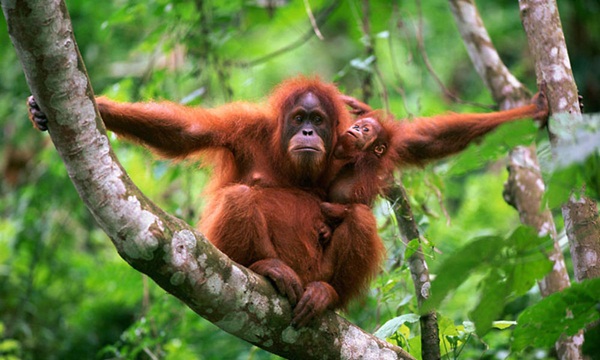
The term "orangutan" is taken from the words in the language of Indonesia, namely ' orang ' which means man and ' utan ' which means forest. Orang utan covers two spesies, namely Sumatran orangutan (Pongo abelii) and the orangutan of Borneo (borneo) (Pongo pygmaeus). Unique is the orangutan has a kinship with a man near at the level of kingdom animalia, where orang utan have DNA in common rate of 59.9%.

They have a fat body and big, big necked, long arms and strong, short legs and bowed, and not mempunyaiekor.
Orangutans have a height of around 1.25-1.5 meters.
Body brownish red hair along with orangutans. They have a large head with high mouth position.
When reaching a level of sexual maturity, males have a fat crush on both sides, the Cantle is great, the hair becomes long and grow a beard around the face. They havethe same human senses, i.e., hearing, sight, smell, taste, and touch.
Males weight about 50-90 kg, while a female orangutan weighs around 30-50 kg.
Palm of the hand they have 4 fingers in length plus 1 thumb. The soles they also have arrangement of fingers or toes are very similar to humans.


Orangutans are still included in the species of great apes such as gorillas and chimpanzees. The great apes entered in the classification of mammals, have a large brain size, which leads to the fore, eyes and hands that can grasp.

On 19 August, lovers of the environment celebrates the world's Orangutans. Although he was welcomed, the warning is always coupled orangutans that concerns still endangered in the IUCN list.

The Sumatran orangutan (Pongo abelii) fall into the category of "being Critically endangered" with the declining trend. While the Bornean orangutan (Pongo pygmeus) includes species that are "Endangered" by the trend also makin dwindled.

But if traced the history of orangutans in the face of the Earth, he is one of the species to adventuring far from Indonesia. Epoch time of the Pleistocene, orangutans can be found as far as southern China and Java. Now, they're having trouble finding suitable habitat away from the reach of mining, forestry, road construction, and illegal logging.


Limited Habitat, only in the North-West of Sumatra and in Kalimantan. The number is? Around 6600 individuals for Sumatran orangutans in 2008. Compare with about 85 thousand individual orangutans in 1900, a decrease of approximately 92 percent.

Preserved as a solution, do conservation activities. Among them is done in Kalimantan Borneo Orangutan Survival through The Foundation (BOSF), which held a program of conservation and rehabilitation of orangutans.

Individual orangutans could be considered again adapt to nature, will dilepasliarkanto forest conservation to the Hill Batikap. However, Ian Singleton, specialist and Director of the orangutan conservation in Sumatran Orangutan Conservation Programme (SOCP), has said that konvservasi is actually risky for the orangutan.
But this had to be done because if it survived in the forest, the orangutan is the more desperate and possibly killed.

The majority of the orangutans eat, including large seed-bearing fruit--a challenge for some particular species. If primates range of orangutans were shifted from the forest contains fruit like this, then the seed of the fruit trees will only spread in short distances or not at all scattered.

The transfer of orangutan forest also have an impact on the reduction of the stock of carbon in the forest. Because tree species with large seeds tend to be in the dense forest that contains more carbon.

(Source: IUCN, orangutans and The Economics of Sustainable Forest Management in Sumatra [UNEP])

Today, both the Borneo orangutans or Sumatran orangutan are threatened by extinction. The World Conservation Union (IUCN Red List IUCN Red List 2007/2007) classify the Borneo orangutan as endangered species (endangered), while in Sumatra have been classified as endangered species (being critically endangered). Both specieshave also been listed in Appendix I of the Convention on international trade in endangered species of Wild Fauna and Flora (CITES). Both in Indonesia and Malaysia, orangutans are protected by law. However, laws and regulations alone is clearly not enough to protect charismatic species. Orangutan conservation requires a comprehensive and integrated efforts by all stakeholders, both in the field and in the political arena, to ensure its success.


This alarming prospect to motivate scientists and conservation groups, government agencies, community and private sectors to find a viable solution to ensure the survival of the species is in the midst of its economic development of Indonesia. The result is a multiple-party conservation strategies that incorporate the interests of the public, private, and local, and find common ground in the conservation of orangutansamong the stakeholders.

In 2007, the Government of Indonesia, which is represented by the Directorate General of forest protection and nature conservation, Forestry Department worked together with the Association Primatologi Indonesia (APAPI) and Orangutan ConservationServices Program (OCSP) funded by USAID, the process that produces the basic framework through briefing stakeholders to deliver improvements in the condition of the orangutan and lowland forest habitat during the next ten years. Strategy and national action plan on the conservation of orangutans 2007 – 2017 was signed by the Ministry of forestry and announced by the President of Indonesia at the climate change conference in Bali in December 2007.

Referring to the plan of action, all of Indonesia's orangutan conservation activities – including that done by BOSF – is based. More than that, the public participation based on kesadartahuan, concern and a love of nature, it is also very necessary to change behaviour to become more environmentally friendly.

The Hornbill Bird


Hornbill Birds or  is a species of bird that has abeak-shaped horns of the cow but without the circle. Usually that light-colored beak. The scientific name "Mascot" refers to the shape of the beak, and has the meaning "ox horns" in the language of Greece. 
Hornbill in the Bucerotidae group belongs to include 57 species. Nine endemic species there of 
originating in the southern partof Africa. The food especially fruits also lizards, bats, rats, snakes and various types of insects. (Source: http://id.wikipedia.org/wiki/Enggang)

63 (Allo, Ruai/term for Dayaks Arue) is a type of bird which is on the island of Borneo. Hornbill has a pretty large body size, which is about 100 cm. There are about 8 different types of Hornbill with body color combination of black and white, while the color of the beak is a mix of yellow, Orange and red. Typical of this is the existence ofbird beak Horn (casque) that grows on the top of its beak. Bird food is figs has specialized nesting behavior. Hornbill has a habit of living pairs and how bertelurnya is an attraction. At the beginning of the period of spawning males make a hole locatedhigh on tree trunks for nesting place and bertelurnya the female then male feeding the birds females through a small hole during the incubation period, and continuing until their children grow up to be a young bird. Why this Hornbill in use as a symbolby the dayak tribe? It symbolises the dayak befits Dove symbolises purity and eternity in Christian religious. Therefore, Hornbill was featured as an example of life for the people of dayak community to keep loving and loved her life partner and parenting them to become an independent and mature dayak. But now this Hornbill is a rare bird that has been very difficult to find in the jungle of borneo, this is because thepengerusakan borneo that constantly occur, such as well logging illegal logging as well as land for Palm oil plantations. The fate of the Hornbill is now the same as the fate of the Dayak tribe in borneo that is increasingly marginalized in their own land.Now this bird as a symbol only and can only be seen in a picture that shows footage of its heyday in the past. It can only be seen as a symbol of that depicted in the form of motifs as in this picture. Pity once their fate. The remaining part of it is just an image and a few parts of the beak and feathers which remain stored neatly by the dayak community.


Based on the trust of the people of old, symbolizing Hornbill is equivalent to symbolizing the Dragon, who considered that the Hornbill as symbolizing nature's top (ceiling) and the dragon as symbolizing nature (land). Here the Hornbill as a guard overnature, and as a manifestation of the balance with nature.
The thinking of the founder of the University of gastric Mangkurat with symbolizingnature's top can be thought of as a manifestation of nature's thought or idea or idea that is perfect with the campus community lives his days studying at the same time knitting ideas of humanity.

The specialities of the Hornbill, namely at a time when the female incubating their eggs until they hatch never left the nest, then the dining needs during the disarang provided by the Hornbill. In terms of food the Hornbill was not too picky an important origin of the fruit that is ripe it will be ate, such as bananas, mangoes, then kestelais also sometimes eat small animals for digestion.
The female Hornbill will long be disarangnya so long as disarangnya the female form covered with a single nest hole is not too large, then the nest was continuously strung together into a large nest if his sons have already hatched, as well as children who have started the great can take this nest of merevarasi be great for his own by connecting from a parent's nest.


Rare wildlife poaching activity protected more languid days. The person catching the animals hunters hunting in many ways. Their purpose is only one, so get the rare animal for sale with exorbitant prices.
Endangered types of poultry also include wildlife is often hunted. One of the Hornbill or often called Hornbill. Birds with specific width and long-beaked it becomes it. As a result, populations of animals that threatened to diminish.
Some time ago in the city of Padang, a number of members of the Hornbill bird hunters arrested police. They bring results found for sale to neighboring countries. According to their confessions, a total of 48 bird beak fruit can be sold at exorbitant prices because it is believed to be efficacious for drugs. In fact there are also making half of the Hornbill for ring and other jewellery.

Because of the difficulty of getting the current Hornbill, Borneo plumage typical of this sale are expensive to Rp.250 thousand($25) per painting.